Market Analysis

Annual market reports; market data resource center; supply chain, financial, and life cycle analyses; pilot studies for renewables and efficiency at scale.

Primary Contact:

Previous and Ongoing Analyses :

Market Analysis for Energy Technologies and Fuels

  • Greene, D.L., Leiby, P.N., Bowman, D. (2007). "Integrated Analysis of Market Transformation Scenarios with HyTrans" ORNL/TM-2007/094, Oak Ridge National Laboratory, Oak Ridge, Tennessee, June. (David Greene, Paul Leiby)
  • Impact of advanced vehicle technologies (e.g. PHEV, EV and FCV) on petroleum use and carbon emissions depends on many technological, behavior, market and policy factors. A consumer choice model with 1458 market segments for the period 2005-2050 has been developed to investigate the drivers and barriers to advanced vehicle technologies. (David Greene, Zhenhong Lin)
  • Impact of supply constraints on new vehicle technology introduction (David Greene, Zhenhong Lin)
  • PHEV usage behavior modeling (David Greene, Zhenhong Lin)
  • Forecasts of annual household demands for alternative automotive fuels at the county level, for the entire United States (Frank Southworth)
  • Limits to market penetration of energy-efficiency technologies – Bjornstad, D.J., A.K. Wolfe, M.V. Lapsa, 2007. Non-Energy Attributes and the Potential Market Penetration of Energy-Efficient Technologies: The Case of Air Source Integrated Heat Pumps and New Residential Markets. ORNL/TM-2007/069, May 2007. Document took a supply-chain perspective (Dave Bjornstad, Amy Wolfe, Melissa Lapsa)
  • Technological learning curve and spillover analysis for enhanced oil recovery. (Jeff Bielicki)
  • NYSERDA Case Studies on Market Penetration of Energy Efficiency Technologies (Bruce Tonn)
  • Nuclear spent fuel transportation model (Shih-Miao Chin and Ho-Ling Hwang)
  • Navy energy use model (Shih-Miao Chin and Ho-Ling Hwang)
  • Estimation of off-highway gasoline use model (Shih-Miao Chin and Ho-Ling Hwang)

Fuel Supply Chains

  • Analysis of ethanol transportation by the domestic truck, marine, and rail distribution system (Shih-Miao Chin and Ho-Ling Hwang)
  • Developed an initial version of a biofuel supply chain model for a multi-state region to identify the spatial distribution of biomass usage, potential refinery locations, distribution patterns, and transportation network utilization. (Mike Hilliard)
  • ORNL led international workshop on Land-use Change and Bioenergy, sponsored by Office of the Biomass Program. Projecting direct and indirect land-use change associated with bioenergy is a necessary precursor to life-cycle analyses for bioenergy (Rebecca Efroymson)

Relevant Areas of Expertise and Capabilities:

Analytical Methods

  • System modeling and optimization (Staff)
  • Estimation and forecasting of demand for household travel and alternative fuels use (Frank Southworth)
  • Leader of ORNL's regional studies program and over-thirty year career, has developed a series of highly successful, data intensive, decision support systems for numerous Federal agencies (Dave Vogt)
  • Combination of engineering and econometric modeling and analysis for heterogeneous technologies, projects, and firms (Jeff Bielicki)
  • Geographic information system design and development (Shih-Miao Chin and Ho-Ling Hwang)
  • Statistical modeling and data analysis (Shih-Miao Chin and Ho-Ling Hwang)
  • Transportation network analysis and system design (Shih-Miao Chin and Ho-Ling Hwang)

Social Science and Economics

  • Social, institutional, and behavioral analyses (Amy Wolfe)
  • Ethnographic (and other) approaches to eliciting perspectives (consumer preferences, supply-chain members' perspectives, etc.) (Amy Wolfe)
  • Economic studies in support of energy policy analysis (Dave Bjornstad)
  • Econometric estimation of the energy use effects of price, income and policy changes ('Debo Oladosu) 
  • Team combines expertise in social and behavioral sciences, engineering, facilities and operations, and technology transfer (Melissa Lapsa, Amy Wolfe, Teresa Baer, Jennifer Palmer, Norm Durfee, James Saulsbury, Kim Grubb, and Missy Sherrod)
  • Travel - urban land use - energy consumption linkages (Frank Southworth)

Supply Chain and Life Cycle Analysis

  • Infrastructure and supply chain analysis for advanced vehicle technologies, including biofuel and plug-in hybrid vehicles (David Greene, Zhenhong Lin)
  • Supply chain modeling, system optimization (Mike Hilliard)
  • Supply chain analysis - assessing/desiging a network of stakeholders and flows to optimize network components, design connections, and flows (Rekha Pillai, et al.)
  • Life cycles analysis - life cycle impacts of system, elements of the system, program impacts, etc.) (Rekha Pillai, et al.)
  • Multimodal transportation analysis of energy commodity flows (Shih-Miao Chin and Ho-Ling Hwang)
  • Case study analysis (Bruce Tonn)
  • Quantitative methods (Bruce Tonn)
Decision support tools for integrated national/regional assessments and energy demand modeling (Colleen Rizy)

Preliminary Ideas on Possible Studies

  • Infrastructure and supply chain analysis for advanced vehicle technologies, including biofuel and plug-in hybrid vehicles (David Greene, Zhenhong Lin)
  • Expand the current spatially-based biofuel supply chain model to incorporate more detailed economic decisions. Use the model to evaluate the effect of policy options (incentives, targets, etc.) on biofuel supply and infrastructure requirements. (Hilliard)
  • Identify and assess social, market and community-level acceptance issues that are major barriers to the broader use of renewable energy technologies (Russell Lee)
  • Stimulate the adoption of green technologies; empirical analysis of factors motivating households to purchase and use energy saving products; detailed description of household behavior and lay a foundation for a wide range of related studies for different sectors and technologies (Dave Bjornstad)
  • Develop computer model that simulates time paths of market penetration for different classes of household energy saving technologies using a household decision function that combines elements of the Rogers theory of heterogeneous adoption with economic information cascade theory (Dave Bjornstad)
  • Systematically identify critical-path decision makers and choices that promote or impinge upon achieving and sustaining energy efficiency in commercial buildings (Amy Wolfe and Melissa Lapsa)
  • Deepen the understanding of the factors that promote or inhibit the realization of potential, designed energy savings in commercial building settings. To achieve this goal, we analyze real-world experiences in retrofitting, monitoring, and verification in different commercial settings (Amy Wolfe and Melissa Lapsa)
  • Estimate market penetration for green energy technologies (Shih-Miao Chin and Ho-Ling Hwang)
  • Estimate acceptance of green energy technology under government incentives (Shih-Miao Chin and Ho-Ling Hwang)
  • Document the current state of electricity industry restructuring, renewable portfolio standards, and cost uncertainties for alternative electricity generation capacities by state using published information. These data will be analyzed using a prototype capacity expansion model constructed for this purpose (Dave Bjornstad)

Highlights

New version of Freight Analysis Framework released
The U.S. Department of Transportation's Federal Highway Administration (FHWA) released its new version of the Freight Analysis Framework, the most comprehensive publicly available data set of freight movement. This tool is developed for FHWA by CTA.

Vehicle Technologies Program Fact of the Week
The Vehicle Technologies Program Fact of the Week provides statistical information on vehicle sales, fuel economy and transportation trends.

2011 Annual Fuel Economy Guide is released
DOE and EPA released the 2011 Fuel Economy Guide, providing consumers with information about estimated mileage and fuel costs for model year 2011 vehicles.

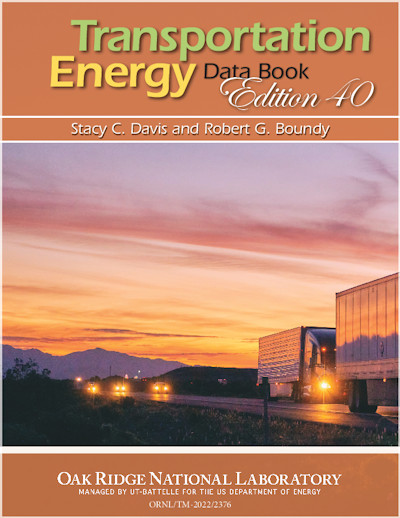
Transportation Energy Data Book: Edition 30 . . .
One of ORNL's most requested documents, this data book details transportation-related energy use in the U.S.